 U.S. Office:

When an international student faces SEVIS termination and falls out of legal F-1 status, they arrive at a high-stakes crossroads: file Form I-539 for Reinstatement within the U.S., or depart the country to execute a Travel and Re-entry on a new initial I-20?
1. The Two Legal Avenues for F-1 Status Recovery
Under Title 8 of the Code of Federal Regulations, an F-1 student who has failed to maintain status has only two formal avenues to regain lawful standing:
- Pathway 1 (In-Country Reinstatement): Submitting Form I-539 to U.S. Citizenship and Immigration Services (USCIS) requesting forgiveness and full restoration of the original SEVIS record.
- Pathway 2 (Travel & Re-entry): Departing the United States, obtaining a brand-new Initial Form I-20, paying a new SEVIS I-901 fee, and seeking admission at a U.S. port of entry.
Choosing the appropriate route is critical. The wrong strategy can permanently invalidate your eligibility for post-graduation Practical Training (OPT) or result in visa denial abroad.
2. Pathway 1 Analysis: In-Country Reinstatement (Form I-539)
Reinstatement asks USCIS to forgive the lapse and reactivate your historical SEVIS record without requiring international departure.
- PRESERVATION OF ACADEMIC TENURE FOR OPT: Your prior semesters remain legally continuous! You do not forfeit eligibility for 12-month post-completion OPT or 24-month STEM extensions.
- No Consular Visa Interview Risk: You remain physically inside the United States, avoiding the scrutiny of a fresh consular interview at a U.S. Embassy abroad.
- Protection Against Port-of-Entry Denials: Bypasses unpredictable CBP questioning at international airport arrival checkpoints.
- Extended Adjudication Timelines: USCIS processing typically ranges from 4 to 12+ months.
- Complete Employment Freeze: You cannot engage in on-campus or off-campus work while your Form I-539 remains pending.
- Strict Evidentiary Burden: You must legally prove the lapse resulted from circumstances beyond your control (medical crisis, school error, unforeseen hardship) with zero record of unauthorized employment.
3. Pathway 2 Analysis: Travel and Re-entry (New Initial I-20)
Travel and Re-entry serves as a complete administrative reset: you abandon the old terminated SEVIS record and establish a brand new SEVIS identity upon entry.
- Immediate Resolution: Status is activated the precise moment CBP admits you at the border. You do not spend months waiting for USCIS mail notices.
- Streamlined School Procedures: DSOs simply issue a new Initial I-20 without assembling the extensive legal briefs required for Reinstatement.
- COMPLETE ACADEMIC CLOCK RESET: Federal law requires completion of 1 full academic year (two consecutive semesters) in active status on the NEW SEVIS record before becoming eligible for CPT or OPT. For seniors or graduate students nearing graduation, this resets OPT eligibility to zero!
- Consular Nonimmigrant Intent Inquiries: If your visa foil is expired, you must interview at an overseas consulate where past status lapses can prompt 214(b) nonimmigrant intent refusals.
- CBP Border Scrutiny: CBP officers inspect your history and possess broad discretion to question past status failures or deny entry.
4. Comprehensive Comparison Matrix
| Evaluation Factor | Reinstatement (Form I-539) | Travel & Re-entry (New I-20) |
|---|---|---|
| Filing Location | Domestic (Remain in the U.S.) | Requires Departure from the U.S. |
| Processing Duration | 4 - 12+ months at USCIS | Instant upon successful re-entry |
| OPT / CPT Accrual | Preserved (Continuous History) | Reset to 0 (Must study 1 full year) |
| Consular Interview | Not Required | Required if current visa stamp is expired |
| International Travel | Prohibited while I-539 is pending | Permitted once re-entry is executed |
| Ideal Candidate | Juniors, Seniors, OPT aspirants | Freshmen with multi-year valid visas |
5. Strategic Recommendations from PN Immigration
There is no universal solution. Choosing between Reinstatement and Re-entry hinges on: how close you are to graduation, your remaining visa validity, the exact termination reason code, and your future career intentions in the U.S.
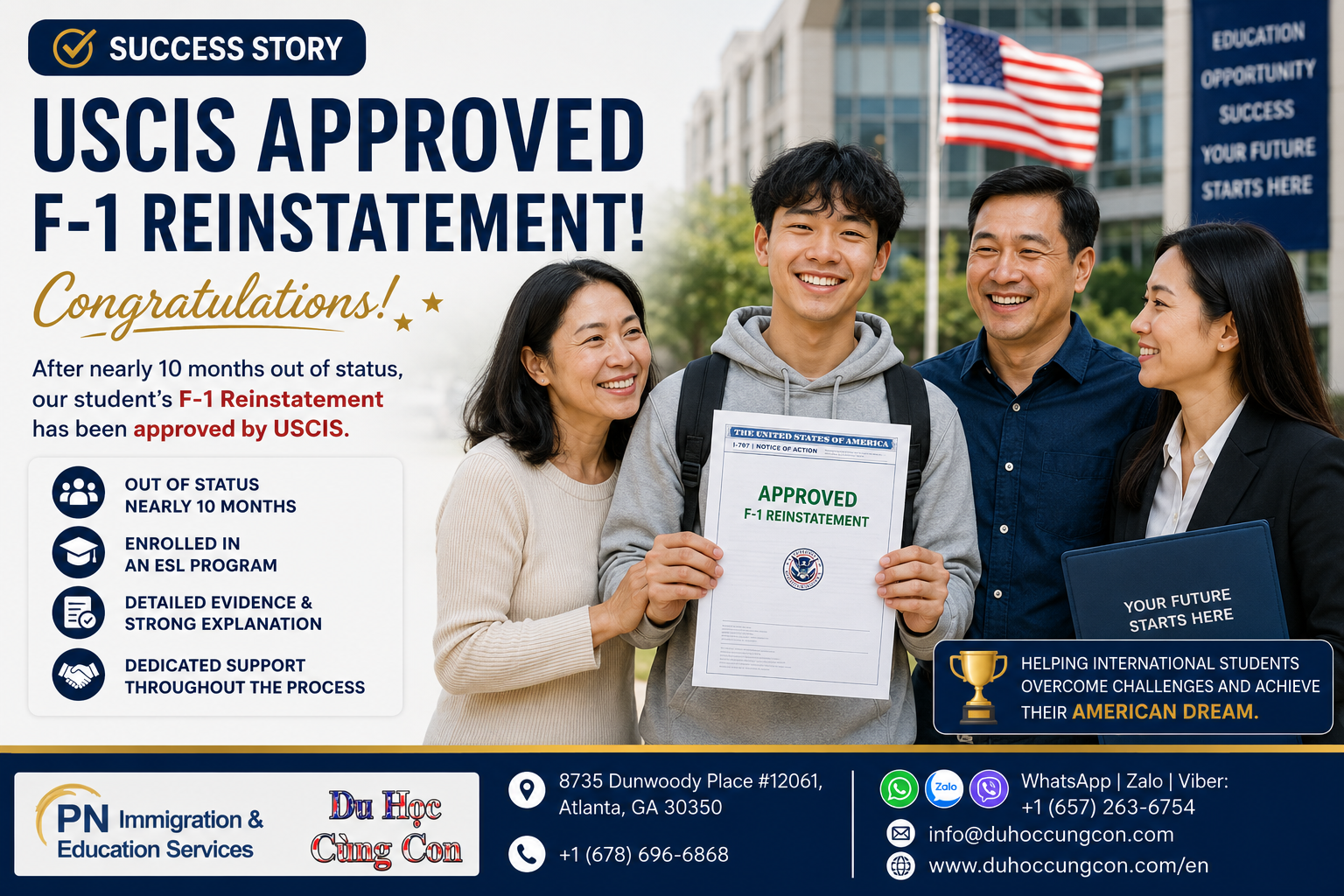
The legal team at PN Immigration has navigated numerous complex reinstatement cases, including successful responses to USCIS Requests for Evidence (RFEs). Contact our specialists to conduct a comprehensive risk audit before committing to either avenue.
Related Case Studies & Resources:
Need Expert Legal & Academic Case Evaluation?
Our specialists at PN Immigration & Education Services are dedicated to providing clear, transparent, and compliant pathways for your journey in the United States.